Macklemore sang for Hind Rajab. The tour went on without him.
Macklemore said “Free Palestine” during Ed Sheeran’s Loop Tour. He was removed from the remaining support dates. The public argument then turned to who had made that decision, and who had the power to force it.
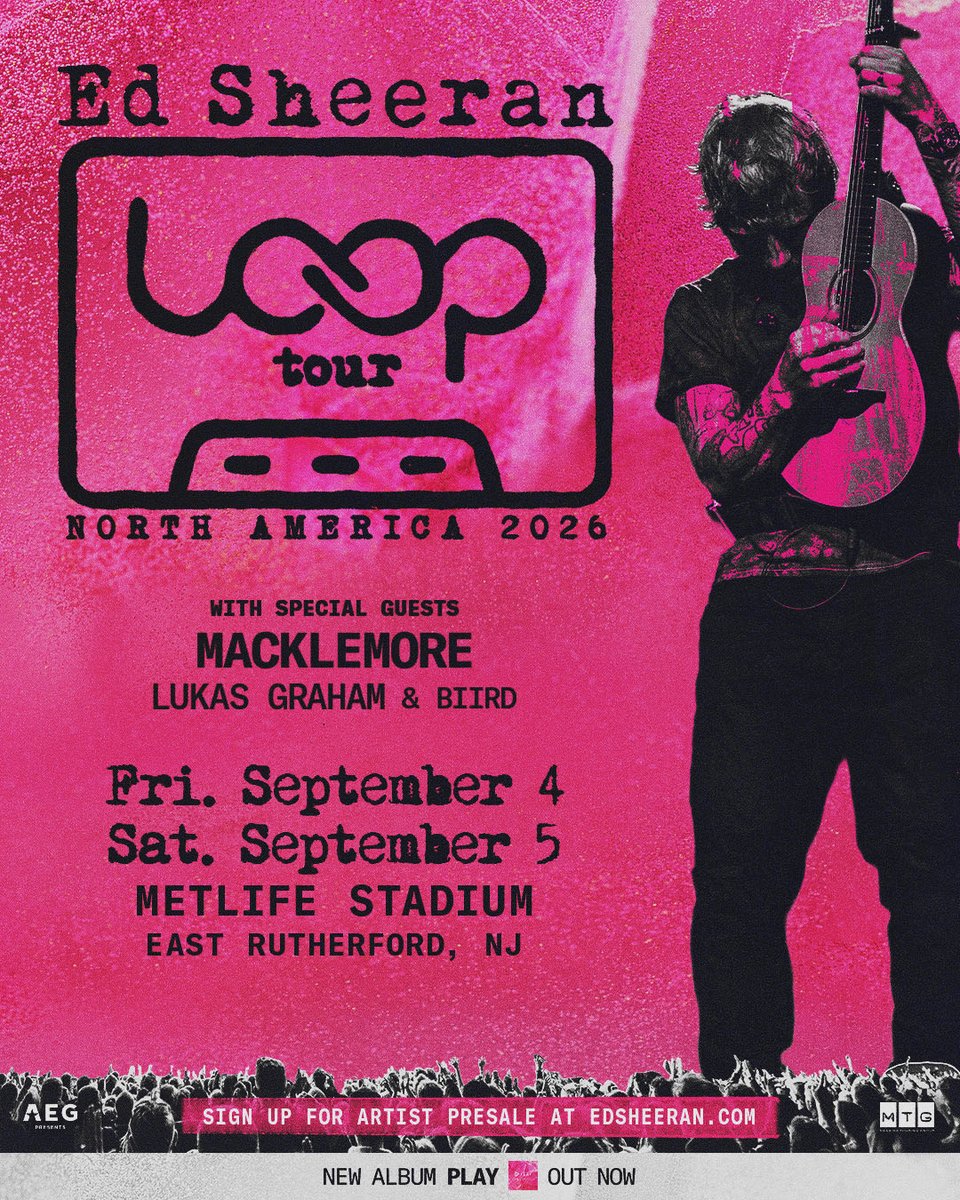
Hind Rajab was a five-year-old Palestinian child killed after Israeli forces fired on her family’s car in Gaza in 2024. Macklemore’s song Hind’s Hall carries her name. At MetLife Stadium in New Jersey on 4 and 5 September 2026, he performed the song, spoke about Gaza and the occupied West Bank, and said “Free Palestine.” The footage accompanying the performance showed destruction in Gaza. Those were not interchangeable symbols in a dispute about concert etiquette. A child had died, and a performer used a stadium stage to point the audience toward her and others living under the war.
Macklemore also addressed Jewish listeners, saying that criticism of Israel was not criticism of them. That statement belongs in the record alongside the objections to his performance. It does not settle every question about the words, images or past conduct that others cited in objecting to him.
On 14 September, Messina Touring Group, the promoter of the US leg of the Loop Tour, confirmed that Macklemore would not perform on the remaining support dates. The promoter said upcoming venues had notified it that they would not allow a concert with him on the bill, risking cancellation and affecting hundreds of thousands of ticket holders. That is the promoter’s account of the operational pressure and its decision. The removal itself is documented.
Robert Kraft, whose organization owns Gillette Stadium, acknowledged an objection to Macklemore appearing there. Kraft cited the recent performance and what he described as a broader history of antisemitic rhetoric and imagery. Macklemore had worn a costume in 2014 that was widely read as an antisemitic caricature and apologized for it. Kraft said his venue decision did not deny Palestinian suffering or the right to advocate for Palestinians. Macklemore rejected the accusation that his criticism of Israel was antisemitic. These are different claims, and the historical costume incident cannot by itself establish what every line of the September performance meant.
Macklemore alleged that Kraft rallied other stadium owners to oppose his continued participation. The promoter reported objections from multiple venues, and Kraft’s Gillette objection was public. The material reviewed here does not independently establish who contacted each venue, what each owner demanded, or whether Kraft organized a coordinated effort. Those parts of the chain remain an allegation rather than an independently established account.
On 15 September, Sheeran said he had tried to broker conversations and that the venue and promoter decision was final. “Macklemore coming off tour was the promoter’s decision, it was not mine,” he wrote. He also said he would not abandon ticket holders, crew and other performers who depended on the tour. His account identifies real obligations, but it does not make his position outside the decision’s consequences. The tour continued without Macklemore; other supporting artists withdrew in solidarity with him.
Sheeran initially described his concerts as a place of safety and sanctuary rather than a political forum. On 19 September in Philadelphia, he apologized for mistakes in his handling of the controversy, called Israel’s war in Gaza “catastrophic and unjustifiable and disproportionate,” and expressed concern about venues vetting performers’ content. His public position changed during the week. The record should carry both statements, in order, rather than freeze him at either one.
The word apolitical did work here. Macklemore’s speech was treated as a political risk. The venue’s power to exclude him, the promoter’s calculation about cancellations and the decision to keep the tour moving could be described as logistics. That difference in vocabulary did not remove politics from the stage. It determined which expression could remain on it.
- What did Macklemore say and show at MetLife, and which specific parts did each objecting venue reject?
- Who communicated each venue objection to the promoter, and what evidence would establish or disprove the alleged coordination among owners?
- When the tour continued without Macklemore, whose speech was classified as political and whose power to decide was described as ordinary business?
The microphone was on. Permission belonged to someone else.
Sources
- MetLife Stadium: Loop Tour announcement naming Macklemore for 4 and 5 September
- Reuters, 14 September: performance, promoter statement, Kraft statement and Macklemore’s allegation
- Associated Press, 14 September: Macklemore’s and Kraft’s statements, with the promoter’s account
- The Guardian, 15 September: Sheeran’s published statement and MetLife remarks
- The Guardian, 19 September: 2014 costume incident, apology and supporting-artist withdrawals
- Reuters, 19–20 September: Sheeran’s Philadelphia speech and continued tour
Release applies to this documented account. The alleged coordination among venue owners remains unresolved and is attributed to Macklemore.