Chud the Builder: Black people as livestream targets.
Dalton Eatherly, known online as Chud the Builder, filmed racist confrontations and invoked free speech. After a shooting outside a Tennessee courthouse, his account, the arrest warrant and surveillance evidence entered a different record. The criminal charges remain allegations to be decided in court.
Eatherly made a spectacle of approaching Black people in public while livestreaming racist language. The Associated Press reviewed video in which he used a racial slur and compared a Black man to a chimpanzee. The people he addressed did not choose to become characters in his stream. Calling the encounter a joke or an exercise in speech did not remove the person on the receiving end, the audience watching, or the risk of escalation.
On 13 May 2026, Joshua Fox was shot multiple times outside the Montgomery County Courts Center in Clarksville and underwent emergency surgery, according to the arrest warrant reported by local journalists. Eatherly was wounded in the arm. These injuries are part of the record regardless of how the criminal case is ultimately resolved.
The Montgomery County Sheriff’s Office charged Eatherly with attempted murder, employing a firearm during a dangerous felony, aggravated assault and reckless endangerment with a deadly weapon. The charges are accusations, not findings of guilt. In an audio account posted after the shooting, Eatherly said he fired in self-defense.
The arrest warrant says Eatherly and Fox argued, Eatherly turned and reached into his jacket for a gun, and a physical struggle followed. At a later hearing, investigators described surveillance footage: Eatherly approached Fox with a selfie stick; after the verbal exchange he walked away, Fox approached, and Eatherly reached for the gun as they fought. Seven cartridge cases were recovered. That is the investigators’ account of evidence presented at a hearing. The complete footage has not been independently reviewed for this article, and the account does not settle the legal question of self-defense.
Eatherly’s earlier videos gave him control over when to approach someone, what to say and what an online audience would see. He defended the content as humor and free expression. The platform supplied a stage and an audience; a later fundraising appeal for his legal defense reportedly collected more than $100,000 in a day. That amount does not establish why he acted as he did outside the courthouse or what he earned from any specific stream.
The courthouse produced other traces: an arrest warrant, surveillance footage described under questioning, testimony, medical injuries and Eatherly’s own claim. Each has a different origin and limit. A clip of a confrontation can establish that certain words were spoken on camera. It cannot, by itself, show everything before and after the clip, establish a person’s intent, or decide whether a shooting was lawful.
A judge sent the shooting case to a grand jury in May and set a $1 million bond. Eatherly was released on bond on 10 August, according to a broadcaster that confirmed the release with the jail. Release is not an acquittal. This article does not claim a later verdict or establish the precise status of every charge after the reported bond release.
The documented racist videos matter to the account of his public conduct. They cannot replace evidence about each movement and decision during the shooting. Fox’s injuries matter independently of the spectacle that followed. A careful record can hold both facts without turning the defendant’s stream into the entire story or declaring the court’s conclusion in advance.
- What do the complete courthouse surveillance recordings show before, during and after the part described at the hearing?
- Which parts of Eatherly’s self-defense account are supported, contradicted or left unresolved by physical and witness evidence?
- How did the livestream and later fundraising shape public attention, and what independent evidence would establish any financial incentive?
The stream was one record. It was never the whole event.
Sources
- Montgomery County Sheriff’s Office statement, 13 May 2026, reproduced by Clarksville Online: arrest and charges
- Clarksville Now, 15 May: reporting from the arrest warrant and arraignment, including Fox’s injuries
- Clarksville Now, 22 May: hearing testimony on surveillance, bond and grand-jury referral
- Associated Press, 13 May: reviewed racist video and Eatherly’s initial account
- Associated Press, republished by the Free Speech Center, 25 May: reviewed streams, self-defense account, fundraising and platform context
- WSMV/Gray News, 10 August: jail confirmation of bond release and Davidson County status
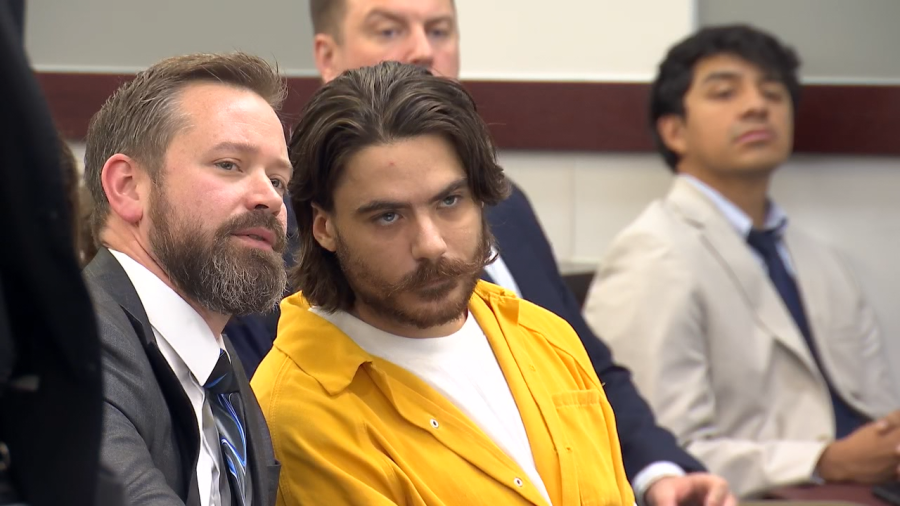
- WKRN, 11 August: bond release report and courtroom still reproduced with this article
The charges and self-defense account are attributed. The complete surveillance recording was not reviewed here. No finding of guilt, motive or platform income is made.