The Pelicot trial: he drugged her. They raped her.
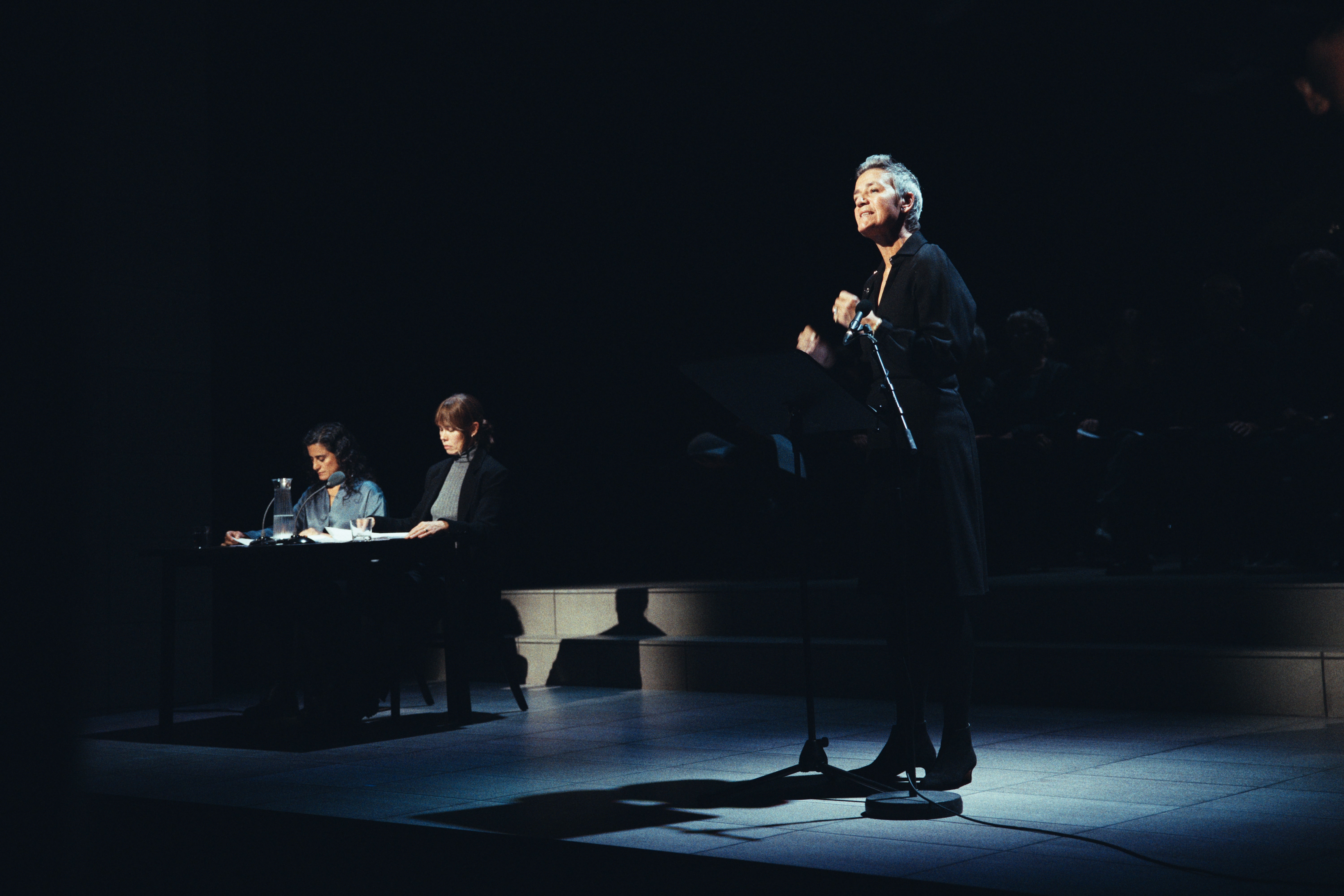
Milo Rau and Servane Dècle’s The Pelicot Trial carries accounts of a public rape trial onto the stage. The words have a history before an actor speaks them. Their passage through reporting, selection and performance is part of the evidence.
Dominique Pelicot repeatedly drugged his then wife, Gisèle, and brought other men into their home to rape her. On 19 December 2024, the court in Avignon convicted all 51 defendants; Dominique received twenty years. The number needs care: Jean-Pierre Maréchal was prosecuted for abuse of his own wife, including facilitating Dominique’s rapes of her, rather than for assaulting Gisèle. A collective count must not erase a second woman.
Gisèle Pelicot chose public proceedings. That decision made the trial available to witnesses beyond the parties, and later to artists working from its accounts. It did not make the suffering fictional. A production has to establish its relationship to that decision rather than treating public knowledge as sufficient authority to speak in her place.
The Vienna Festival describes the work as a scenic oratorio, restaged in local languages with changing casts of actors and public figures. Its first performance was in Vienna on 18 June 2025; the Avignon presentation followed on 18 July. The festival’s programme describes readings of examinations, pleas and commentary, developed with lawyers, experts, witnesses and feminist organisations. This is an assembled account with several kinds of speaker.
At Betty Nansen Teatret on 28 August 2026, the announced Copenhagen version involved more than thirty Danish actors and public figures, with translation by Madame Nielsen. The theatre listed four hours and thirty minutes, without an interval, while allowing people to leave and return. It also stated that the production had Gisèle Pelicot’s permission. That is a documented statement by the presenting theatre; the underlying agreement and its scope are not available in this source packet.
In the creators’ published interview, Dècle identifies journalists’ notes from nearly six hundred hours of hearings as a pivotal source, supplemented by conversations with reporters, researchers, a prosecutor, Pelicot’s lawyers and feminists. She acknowledges the limits of reconstruction. The production’s published description also lists interviews, expert opinions and commentary among its materials. Calling all of this a court transcript would give unlike records the same authority.
The chain matters: a statement is heard, recorded in a reporter’s notes, selected for a script, sometimes translated, and spoken by another person. Each passage can preserve meaning; each also introduces a decision. A defendant’s explanation remains that defendant’s explanation. A scholar’s interpretation remains an interpretation. An actor’s conviction, rhythm or pause cannot turn either into a judicial finding.
NYU Skirball’s presentation describes the work as readings of examinations, pleas and commentaries, performed at Judson Memorial Church in March 2026. The location and the assembled speakers are theatrical choices. A church, a theatre and a courtroom offer different expectations about judgment, attention and belief. Moving the words changes the conditions in which they are heard, even where their wording is preserved.
The Copenhagen cast likewise brought publicly recognizable people to the act of reading. Their presence can direct attention toward material an audience might otherwise avoid. Recognition can also lend borrowed credibility to a statement. The question for this audit is where that credibility belongs: to the documented source, the performer, or the arrangement that places one beside another. These are risks of the form, not claims about what every spectator experienced.
The Avignon programme frames the work as an examination of patriarchy. Dècle’s interview draws a useful boundary: a court determines individuals’ responsibility and cannot sentence an entire society. The broader structural account belongs to the artists’ argument. It has to be assessed through the connections it establishes, rather than borrowed from the existence of guilty verdicts.
The same interview questions the demand for an exemplary victim. That challenge matters to the tribute: admiration for Pelicot’s public decision must not become a condition imposed on someone who chooses privacy. The work’s stated purpose and permission support an account of its intentions. They do not establish every effect of its staging. This article audits published descriptions and the creators’ account; it does not claim attendance or a line-by-line comparison of the performed script with the trial record.
- Can each performed statement be traced to testimony, reporting, an interview or commentary, with its original speaker identified?
- Which choices of selection, translation and delivery change what the audience is invited to believe?
- Where does the court’s finding end and the production’s argument about society begin?
The voice onstage inherits a duty to the source.
Sources
- Reuters, 19 December 2024: verdicts, Dominique Pelicot’s sentence and the separate Maréchal case
- Vienna Festival: scenic oratorio, local restaging and dated performance history; press photograph and editorial reproduction terms
- Festival d’Avignon, 2025 programme: readings, collaborators and the production’s structural framing
- Betty Nansen Teatret: Copenhagen date, cast, translation, duration and statement of permission
- Vienna Festival press dossier: Natalie Assmann’s interview with Rau and Dècle, conducted 16 March 2025, pp. 5–7
- NYU Skirball: New York presentation at Judson Memorial Church, 29 March 2026
A source-based analysis of the adaptation, not an eyewitness performance review. Permission is attributed to the theatre. The script, journalists’ complete notes and permission agreement have not been independently inspected. Reported 2024 findings are historical context, not a complete account of subsequent proceedings.